Maryam Ko Bataen Program 1000 Helpline
Most people assume government relief programs are built around bureaucracy, long queues, middlemen, and delayed disbursements. The Maryam Ko Bataen initiative flips that assumption entirely. Launched under the leadership of Maryam Nawaz Sharif, this integrated citizen facilitation system is not merely another welfare scheme, it is a technology driven commitment by the Government of Punjab to make public welfare services genuinely fast, transparent, and free of cost.
What sets it apart is its secure digital platform that doesn’t just register complaints, it actively connects people with district administrations and relevant government departments, making dignified service delivery a measurable outcome rather than a political promise. The program was announced via X and operationalized from the first of Ramazan, specifically targeting deserving families facing acute financial hardship, particularly those who had fallen through the cracks of existing welfare frameworks.
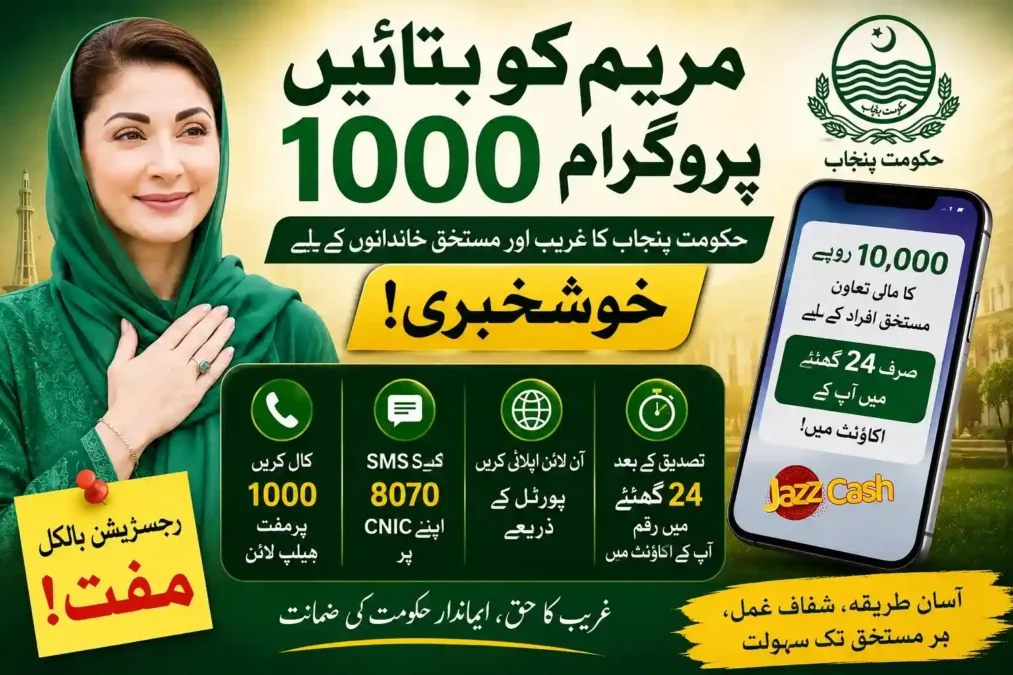
What makes this initiative truly different is its centralized complaint and relief management mechanism, designed to enforce accountability at every step. Within just 10 days of launch, over 1.1 million citizens had already registered, reflecting a level of public confidence rarely seen in Punjab’s welfare history. Saima Farooq, Chairperson of the 1000 Helpline and Chief Minister’s Complaint Cell, confirmed that eligible individuals began receiving Rs10,000 directly into their JazzCash mobile wallets within 24 hours of verification, processed through wealth filtering against CNIC records stored in official databases. Citizens reached the program through multiple methods:
- Phone registration
- SMS verification using 8070
- Online application through the web portal
This makes the initiative a genuinely omni-access Ramadan Relief Program built around real eligibility needs of financially struggling families across every household in Punjab. The system’s reliance on live tracking, digital record-keeping, and monitoring ensures transparency throughout, a rarity in traditional relief and redressal initiative frameworks and a defining feature of responsive governance reaching four million intended beneficiaries and extending well beyond them through the essential support services this program continues to deliver.
Hazrat Ibrahim aur Hazrat Ismail ka waqia hamein sacrifice, obedience aur faith ka asal lesson deta hai. Allah ne unki niyyat aur farmabardari ko pasand farmaya, aur isi yaad mein har saal Musalman Qurbani karte hain.
Key Features and Components
Here’s a perspective most welfare program discussions overlook. The infrastructure behind a relief system matters far more than its announcement. The 1000 short code is not just a helpline number, it is the nerve center of a province wide complaint and relief management system built to handle Punjab’s scale without collapsing under demand.
Every citizen call, every digital submission, and every SMS ping feeds into a centralized engine where automated task assignment routes each case directly to concerned officers, eliminating the human bottleneck that has historically weakened government welfare execution.
Core Features
| Feature | Description |
|---|---|
| Centralized Complaint System | All requests are managed through one integrated platform |
| Automated Task Assignment | Cases are routed directly to relevant departments |
| Real-Time Tracking | Citizens can monitor complaint and application progress |
| Omni-Channel Access | Available through helpline, SMS, app, and web portal |
| Digital Record Keeping | Ensures transparent and auditable operations |
| 24/7 Support Infrastructure | Emergency and welfare requests handled continuously |
What this means practically is that real time registration and tracking are not features added for optics, they are structural necessities keeping the entire omni channel architecture honest, whether the citizen approaches via mobile application, web portal, or phone call.
Verification and Transparency System
The verification layer is where this system earns genuine trust. Every applicant’s CNIC is run against official government databases, not manually reviewed but digitally cross-referenced, producing a secure eligibility outcome within hours.
Verification Workflow
- Applicant submits CNIC and household details
- System cross-references official databases
- Eligibility status is generated digitally
- Officers verify service delivery
- Photo and video proof is uploaded
- Citizens receive confirmation and tracking updates
Officers are then required to submit photo and video proof of service delivery, feeding into transparent service timelines that are auditable against defined turnaround time benchmarks.
This direct coordination between the helpline infrastructure and district administrations across relevant departments ensures that 24 hours support for emergency and welfare services is not a campaign slogan but an operationally enforced standard. Coverage remains province wide, and live tracking combined with digital record-keeping and ongoing monitoring gives both citizens and administrators a shared, real-time view of transparency in action, something traditional relief pipelines were never designed to provide..
Services Available
The real measure of any welfare program is not how it is announced but what it actually delivers at the ground level. The Maryam Ko Bataen Program 1000 covers a deliberately wide spectrum of necessities because genuine financial hardship rarely arrives in a single category.
Major Services Offered
| Service Category | Details |
|---|---|
| Ration Support | Essential household food assistance |
| Medical Assistance | Medicines, hospital facilitation, emergency care |
| Specialized Treatments | Dialysis, cancer treatment, cardiology care |
| Financial Assistance | Monetary support based on eligibility |
| Disability Support | Wheelchairs, hearing aids, assistive devices |
| Winter Relief | Warm clothing and blankets |
| Marriage Grants | Financial support through Bait-ul-Maal |
Medical Emergency Support Includes
- Medicines
- Hospital facilitation
- Dialysis support
- Cancer treatment assistance
- Cardiology care
Beyond medical needs, financial assistance is made available subject to eligibility criteria, ensuring that disbursements flow only toward genuinely deserving applicants rather than becoming a parallel entitlement channel.
What distinguishes this program’s service architecture is its attention to categories that most relief frameworks quietly ignore. Assistive devices for persons with disabilities, including wheelchairs and hearing aids, are part of the official support inventory, acknowledging that disability-related poverty operates on a different financial pressure curve than general income poverty.
Essential items such as warm clothing and blankets address seasonal vulnerability, particularly critical during winter months when low-income households face compounded hardship. For families navigating major life transitions under financial strain, marriage grants are available through Bait-ul-Maal, a recognition that economic dignity extends beyond daily survival into life milestones that poverty should not permanently foreclose.
Eligibility Criteria
Eligibility frameworks are where most government programs reveal their real intentions, and the Maryam Ko Bataen criteria make a deliberate choice to prioritize structural vulnerability over administrative convenience.
Basic Eligibility Requirements
| Requirement | Details |
|---|---|
| Residency | Must be a resident of Punjab |
| CNIC | Valid CNIC required |
| Age | Minimum 18 years |
| Income Status | Must belong to a low-income household |
| Employment Status | Cannot hold a high-salary government position |
These baseline conditions exist not as bureaucratic gatekeeping but as a filtering mechanism ensuring that financial hardship, not political proximity, determines approval.
Priority Categories
The program specifically prioritizes:
- Families facing medical emergencies
- Daily wage workers
- Widows
- Elderly citizens
- Disabled individuals
- Families listed in poverty databases
- Unemployed households
- Women heading households
- Recently unemployed individuals
Disqualified Applicants
| Disqualification Category | Reason |
|---|---|
| High Salary Government Employees | Already financially stable |
| Overseas Taxpayers | Outside intended relief category |
| Large Business Owners | Higher financial capacity |
| Multiple Property Owners | Significant asset ownership |
| Luxury Vehicle Owners | Indicates financial stability |
| False Information Providers | Fraud prevention |
| Existing Relief Beneficiaries | Prevents duplicate welfare support |
Critically, those already receiving government aid through Benazir Income Support Programme or the Prime Minister’s Ramazan Relief Programme are not eligible, preventing duplication across welfare channels.
The digital verification process cross-references national records, income information, asset ownership, and welfare history to enforce fair distribution and prevent fraud.
Women, particularly those who are head of household, widowed women, and financially independent female applicants, are actively encouraged to apply using their own CNIC.
Special consideration is also extended to recently unemployed individuals, families facing medical emergencies, and households hit by sudden financial crisis because the program recognizes that vulnerability is not always chronic. Sometimes it arrives without warning and demands an equally immediate institutional response.
The system’s reliance on low monthly household income as a core filter, verified against official government databases, ensures that approval decisions reflect ground reality rather than self-reported estimates alone.
How to Apply
One of the more quietly significant design decisions in the Maryam Ko Bataen system is its deliberate departure from how relief schemes have traditionally operated in Pakistan. Gone are the physical visits to government offices, the long queues that consumed working days, and the middle agents who extracted unofficial fees for doing nothing more than submitting a form.
The digital application process built around modern digital systems replaces all of that with:
- Toll-free helpline access
- SMS eligibility verification
- CNIC-based verification system
- Real-time application tracking
- Corruption-free registration process
Registration Methods
| Method | Process |
|---|---|
| Helpline 1000 | Call, provide CNIC and household details, receive SMS confirmation |
| Mobile App | Create account, verify OTP, apply and track status |
| SMS 8070 | Send CNIC and household information through SMS |
Helpline 1000 Registration Steps
- Call the toll-free helpline
- Select preferred language
- Share CNIC number
- Provide household income details
- Submit registration request
- Receive SMS confirmation and reference number
Mobile App Registration Steps
- Download and open the app
- Create account using Full Name and email
- Complete OTP verification
- Access dashboard
- Submit Ramadan Relief Rs 10,000 application
- Track application status in real time
SMS 8070 Registration
Applicants can send:
- CNIC number
- Registered mobile number
- Household income estimate
- Residential address
This method offers the most accessible entry point for citizens with basic phones.
Across all three methods:
| Timeline | Expected Duration |
|---|---|
| Rejection Notification | 24 to 48 hours |
| Successful Verification | 3 to 4 days |
| Approval Notification | Sent directly after verification |
No follow-up visits or intermediary confirmations are required.
Program Statistics, Approval Tips, and Common Mistakes
The numbers behind the Maryam Ko Bataen rollout tell a story that statistics rarely manage to capture with this kind of clarity.
Registration Statistics
| Registration Source | Total Registrations |
|---|---|
| Mobile App | 910,000 |
| Helpline | 140,000 |
| Web Portal | 50,000 |
Additional key figures include:
- More than 100,000 daily registrations on average
- 1.8 million call attempts recorded in a single hour
- Every applicant received a unique tracking ID
- Beneficiaries received updates through SMS alerts and robo-calls
Perhaps the most telling figure is the 1.8 million call attempts recorded in a single hour, reflecting extraordinary public confidence in the program and in chief minister leadership at a moment when Punjab’s lower-income population needed an accessible and dignified channel to communicate genuine need.
How to Improve Approval Chances
| Recommendation | Why It Matters |
|---|---|
| Provide accurate information | Prevents verification failure |
| Use your own CNIC | Ensures proper identity validation |
| Keep mobile number active | Required for SMS updates |
| Avoid duplicate applications | Multiple entries may trigger rejection |
| Submit honest information | Backend verification is extensive |
Honesty throughout the process is not just an ethical requirement, it is a practical one given how thoroughly the backend verification operates.
Common Mistakes to Avoid
- Submitting incorrect CNIC numbers
- Paying agents who promise faster approval
- Sharing OTP codes with strangers
- Applying multiple times unnecessarily
- Believing unofficial fee rumors
The entire registration process is completely free, a fact worth repeating because misinformation around unofficial fees continues to circulate despite the program’s explicitly corruption-free design.