Pakistan Poverty Alleviation Fund (PPAF): Programs & Impact

Poverty remains one of the most pressing socioeconomic challenges facing Pakistan. Over the decades, numerous public and private initiatives have attempted to address income inequality, limited access to financial services, unemployment, poor infrastructure, and social exclusion. Among these initiatives, the Pakistan Poverty Alleviation Fund (PPAF) has emerged as one of the country’s most influential institutions dedicated to poverty reduction and community-driven development.
Established in 1999, PPAF operates as an autonomous not-for-profit apex development organization that channels financial and technical resources to underserved communities through a network of partner organizations across Pakistan. Supported by the Government of Pakistan, the World Bank, and several international development agencies, PPAF has played a vital role in empowering vulnerable populations through microfinance, interest-free loans, livelihood programs, education initiatives, disaster resilience projects, and community infrastructure development.
Today, PPAF continues to strengthen local institutions, promote financial inclusion, create sustainable livelihood opportunities, and support marginalized communities in both rural and urban areas of Pakistan.
What Is the Pakistan Poverty Alleviation Fund (PPAF)?
The Pakistan Poverty Alleviation Fund (PPAF) is Pakistan’s leading poverty reduction institution that works to improve the lives of poor and disadvantaged communities through community-driven development programs.
Unlike traditional welfare programs that focus primarily on direct assistance, PPAF emphasizes long-term economic empowerment by increasing access to:
- Microfinance services
- Interest-free loans
- Livelihood opportunities
- Community infrastructure
- Education and skills development
- Disaster risk reduction
- Renewable energy solutions
- Women’s economic empowerment
The organization operates through a vast network of civil society organizations, community-based organizations (CBOs), and partner institutions that implement development projects at the grassroots level.
History and Establishment of PPAF
The Pakistan Poverty Alleviation Fund was established in 1999 in response to growing concerns about persistent poverty, social exclusion, and limited economic opportunities for marginalized communities.
The institution was created with support from the Government of Pakistan and the World Bank to serve as an intermediary apex body capable of delivering development resources efficiently to communities often overlooked by conventional development programs.
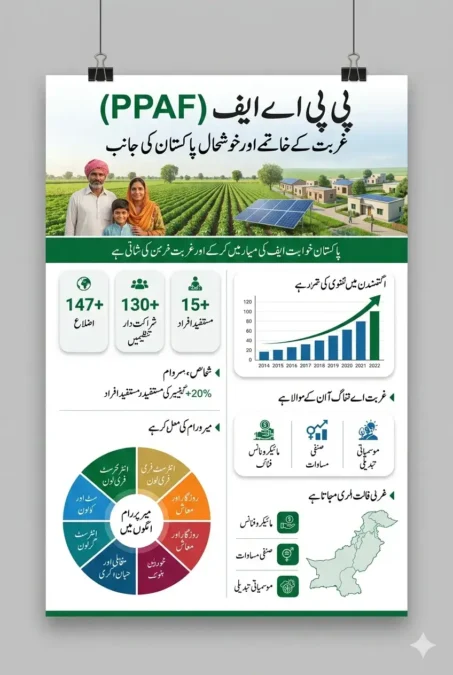
Since its inception, PPAF has evolved into one of Pakistan’s largest development organizations, extending its reach to more than 140 districts through partnerships with over 130 local organizations.
Mission of PPAF
PPAF’s mission is centered on empowering poor and vulnerable populations by providing equitable access to opportunities that increase incomes, improve livelihoods, and enhance overall quality of life.
Rather than creating dependency, the organization focuses on enabling individuals and communities to become self-reliant through sustainable economic development.
Key Mission Priorities
- Reducing poverty across Pakistan
- Expanding economic opportunities
- Promoting social inclusion
- Empowering women and marginalized groups
- Strengthening local institutions
- Supporting community-driven development
Goals and Objectives of PPAF
The primary goal of PPAF is to alleviate poverty by increasing access to income-generating opportunities and essential socioeconomic services.
Major Objectives
Strengthening Civil Society Institutions
PPAF works to enhance the institutional capacity of local organizations that serve vulnerable communities.
Promoting Financial Inclusion
The organization provides access to microfinance and interest-free lending programs that help low-income households start businesses and improve livelihoods.
Expanding Market Access
PPAF supports poor communities by connecting them to markets and creating opportunities for sustainable income generation.
Improving Public Services
The institution helps improve access to quality health, education, and community infrastructure services.
Building Community Resilience
PPAF develops programs that help communities prepare for and recover from disasters and climate-related challenges.
Core Values of PPAF
he success of PPAF is guided by a strong set of organizational values that influence every project and partnership.
Transparency
Maintaining openness in financial management, decision-making, and project implementation.
Accountability
Ensuring measurable outcomes and responsible use of resources.
Social Inclusion
Promoting equal participation of:
- Women
- Children
- Elderly populations
- Persons with disabilities
- Indigenous communities
- Religious minorities
Democratic Governance
Supporting community participation in planning and development processes.
Sustainability
Ensuring that development interventions create long-term positive impacts for future generations.
Organizational Overview
| Category | Details |
|---|---|
| Organization Name | Pakistan Poverty Alleviation Fund (PPAF) |
| Established | 1999 |
| Headquarters | Islamabad, Pakistan |
| Organization Type | Not-for-Profit Apex Development Institution |
| Geographic Reach | 140+ Districts |
| Partner Organizations | 130+ |
| Core Focus Areas | Poverty Reduction, Financial Inclusion, Livelihood Development |
PPAF operates from its headquarters in Islamabad and coordinates development interventions through an extensive network of local implementing partners nationwide.
How PPAF Reduces Poverty in Pakistan
PPAF’s poverty alleviation strategy is based on addressing the root causes of poverty rather than providing temporary relief.
Financial Inclusion
Access to financial services enables households to invest in income-generating activities and build economic resilience.
Livelihood Development
The organization supports entrepreneurship, vocational training, and market-driven economic opportunities.
Community Infrastructure
Projects include:
- Water supply systems
- Roads and bridges
- Renewable energy facilities
- Community centers
Women’s Economic Empowerment
Special emphasis is placed on increasing women’s participation in economic activities through access to finance, skills training, and entrepreneurship opportunities.
Role of PPAF Microcredit in Poverty Alleviation
One of the most impactful components of PPAF’s poverty reduction strategy has been microcredit.
Through partnerships with local organizations, PPAF has enabled thousands of low-income households to access financing for small businesses and productive activities.
Initial Partner Organizations
The first partner organizations included:
- Taraqee Trust
- Aga Khan Rural Support Programme (AKRSP)
- National Rural Support Programme (NRSP)
- Family Planning Association of Pakistan (FPAP)
- Kashf Foundation
These organizations helped establish the operational foundation for PPAF’s microfinance model.
Impact of Microcredit
Research conducted through program evaluations demonstrated that:
- Household incomes increased significantly
- Borrowers moved into higher income categories
- Poverty levels declined among participating households
- Women’s economic participation improved
Major PPAF Programs and Projects
National Poverty Graduation Programme (NPGP)
The National Poverty Graduation Programme is one of PPAF’s flagship initiatives designed to help extremely poor households achieve sustainable livelihoods and financial independence.
Interest-Free Loan Programme
This program provides Shariah-compliant interest-free loans to vulnerable populations across Pakistan.
Benefits
- Business startup support
- Income generation opportunities
- Improved household financial stability
- Reduced dependence on informal lenders
Growth for Rural Advancement and Sustainable Progress (GRASP)
GRASP supports rural economic development by promoting employment and entrepreneurship opportunities in agriculture and livestock sectors.
Building Resilience to Disasters and Climate Change (BRDCC)
This initiative helps communities strengthen disaster preparedness and climate resilience.
Programme for Poverty Reduction (PPR)
The PPR initiative focuses on:
- Health services
- Education
- Community infrastructure
- Skills development
- Sustainable livelihoods
Revitalising Youth Enterprise (RYE)
The RYE program equips young people with:
- Digital marketing skills
- Graphic design expertise
- Social media management training
- Financial literacy education
Renewable Energy Initiatives
PPAF supports:
- Mini hydropower projects
- Solar energy systems
- Community energy solutions
These initiatives improve energy access while supporting sustainable development.
Key Impact Areas of PPAF
PPAF’s development interventions focus on multiple sectors that directly influence poverty reduction.
Impact Areas
- Microfinance
- Poverty Graduation
- Livelihood Development
- Gender Equality
- Education
- Health
- Climate Change Adaptation
- Disaster Risk Reduction
- Renewable Energy
- Water and Infrastructure Development
- Institutional Strengthening
- Social Inclusion
Key Funders and International Partners
PPAF’s work is supported by a diverse network of development partners.
Major Funding and Development Partners
- World Bank
- Government of Pakistan
- International Fund for Agricultural Development (IFAD)
- European Union (EU)
- KfW Development Bank
- United Nations High Commissioner for Refugees (UNHCR)
- Asian Development Bank (ADB)
- Citi Foundation
- Food and Agriculture Organization (FAO)
- International Trade Centre (ITC)
- Opportunity EduFinance
These partnerships have enabled PPAF to scale development interventions across Pakistan.
Conclusion
The Pakistan Poverty Alleviation Fund (PPAF) has established itself as one of Pakistan’s most impactful development institutions. Through its focus on poverty reduction, financial inclusion, livelihood development, education, disaster resilience, and community empowerment, PPAF has transformed the lives of millions of people across the country.
By combining grassroots participation, strong partnerships, evidence-based programming, and sustainable development approaches, PPAF continues to play a critical role in building a more inclusive and prosperous Pakistan.
As Pakistan confronts emerging economic and social challenges, the importance of institutions like PPAF will only continue to grow, making it a cornerstone of the country’s long-term poverty alleviation and development agenda.


