NSER Survey 2026 Registration & Tracking by CNIC | 8171 Eligibility Check
BISP established the National Socio-Economic Registry (NSER) in 2011 as a central data repository to record the socio-economic status of households across the country. The first data collection exercise in 2010 physically reached the doorstep of every household, covering 27 million HHs for the first time. That ground-level collection effort, focused on visiting every home, brought real objectivity and transparency to beneficiary targeting. The dataset became a shared platform used by both public sector and private sector social protection programmes for ten years, driving improvement in targeting efficiency and making any Social Safety Program pivotal to those in need.
Socio Economic Registries face errors at two levels — the design level and implementation level — and frequency of updates is a key factor. Conventionally, a registry is updated at an interval of 3 to 5 years to capture changing demographic trends. The real strength lies in dynamic inclusion, keeping registrationopen and continuous through an on-demandapplication window as a citizen interface, so anyone can registeranytime when situations change or emergencies and shocks hit. This shock-responsive and adaptive social protectionprinciple gives stakeholders the capabilities of responding fast. The National Roll-out 2018-19 united BISP Headquarters, Tehsil Offices, Implementing Partner, Data Collection Firms, Operations Review Firm, Ministry of Poverty Alleviation, Social Safety, NADRA, Provincial Education Departments, World Bank, Asian Development Bank, and Foreign Common wealth Development Office, United Kingdom for a single execution with shared access and consideration for potential eligibility across all social programs.
Latest NSER Survey 2026 Update
The National Socio-Economic Registry (NSER) has moved away from the old static survey model — no more waiting for door-to-door surveys or batch surveys that skipped entire communities. The system has evolved into a Dynamic Registry, meaning Households can now self-register and update their socioeconomic data on-demand, without waiting for the government to knock on their door. If your household has gone through a change in financial circumstances — job loss, a new disability, or a shift in family composition — you no longer have to sit and wait. Dynamic Registration puts that control back in your hands, and from what I have seen helping families navigate this process, that shift alone has made a real difference for people who were previously left out of the system entirely.
What makes the 2026 update truly different is how tightly everything is now verified. Your registry data — including your CNIC, marital status, disabilities, and family composition — goes through strict NADRA Cross-Validation, meaning every detail is biometrically cross-validated against the central database. Your active NSER survey must reflect a Proxy Means Test (PMT) poverty score of 32 or below to maintain Payment Eligibility for relief programs. If your data is not updated within the 2-year window, your BISP payments and benefits get automatically blocked — and that is not a warning most families can afford to ignore. The dynamic resurvey option exists precisely for this reason, so use it before that window closes.
NSER Survey Online Registration Check By CNIC
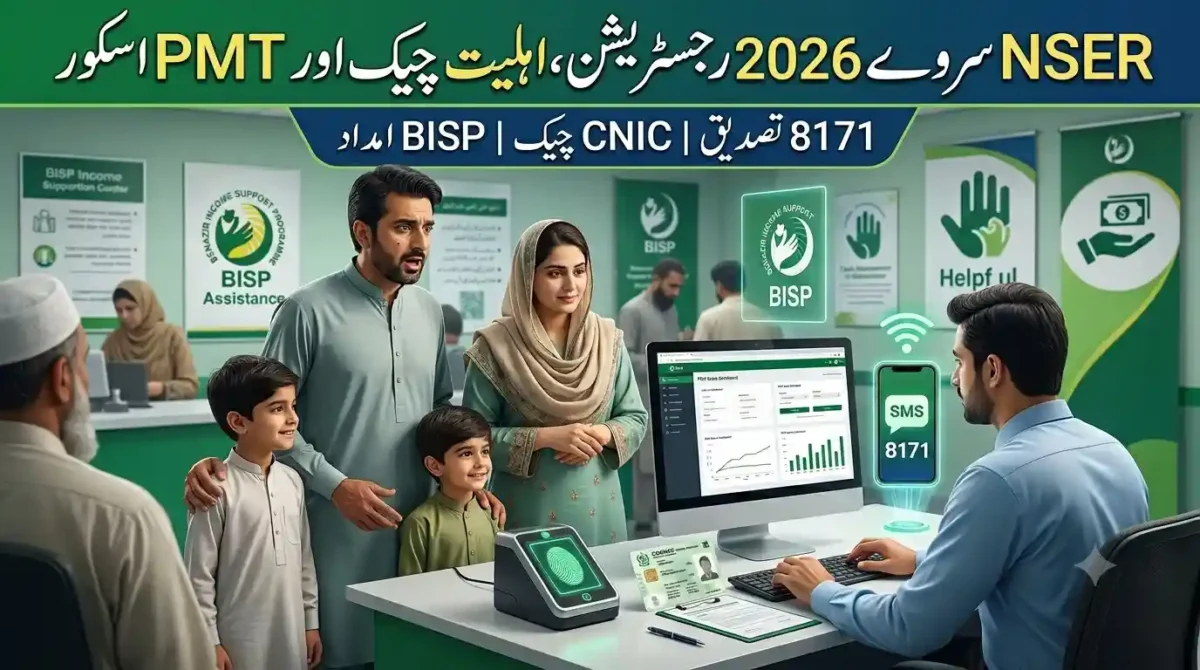
The Government of Pakistan has made it easier for citizens to verify their NSER survey records and eligibility status through multiple official channels. Whether you want to confirm your registration, check your eligibility for BISP assistance, or verify your survey information, you can use your Computerized National Identity Card (CNIC) to access your status. The verification process is connected with the National Socio-Economic Registry (NSER), the Benazir Income Support Programme (BISP), and NADRA databases to ensure accurate beneficiary identification and transparent distribution of financial assistance.
Method 1 – Through 8171 Web Portal
The 8171 Web Portal is one of the most convenient ways to check your NSER survey status online. Individuals who have already completed the NSER Dynamic Survey can use the portal to verify their eligibility, registration details, and payment status.
To check your status online:
- Visit the official 8171 web portal.
- Enter your 13-digit CNIC number without dashes.
- Complete the captcha verification.
- Submit your information.
- Review your eligibility and survey status displayed on the screen.
The portal allows beneficiaries to verify whether their household information is available in the NSER database, whether they qualify for financial assistance, and whether any additional verification is required. The system is regularly updated to reflect changes made through the Dynamic Survey process.
Method 2 – Through SMS Service
Individuals without internet access can use the official 8171 SMS service to check their NSER survey status. This method is particularly useful for residents in rural areas who may not have access to smartphones or computers.
Follow these steps:
- Open the messaging application on your mobile phone.
- Type your 13-digit CNIC number.
- Send the CNIC number to 8171.
- Wait for a confirmation message regarding your eligibility and registration status.
After processing your request, the system will provide information such as eligibility status, verification requirements, pending survey notifications, or registration updates. The SMS service is linked to official BISP records and helps beneficiaries receive quick updates without visiting an office.
Method 3 – Visit Nearest BISP Tehsil Office
If your CNIC record is not available online, your information is under verification, or you need to update household details, visiting the nearest BISP Tehsil Office is the recommended option.
At the registration center, officials can:
- Verify your NSER survey record.
- Update household and family information.
- Conduct the Dynamic Survey if required.
- Resolve CNIC verification issues.
- Assist with biometric authentication.
- Review eligibility concerns and registration status.
Applicants should carry their original CNIC and any supporting documents that may be required during verification. In many cases, families whose records are incomplete or outdated are instructed to complete the Dynamic Survey at a BISP registration center before their eligibility can be reassessed. Physical verification remains an important part of the registration process because final NSER enrollment and data validation are generally completed through authorized BISP offices rather than through a fully online registration system.

Punjab Laptop Scheme 2025: 110,000 Free Laptops Guide
Exciting News: CM 3 Marla Plot Scheme 2025 The CM Punjab Laptop Scheme 2025 is a complete guide covering eligibility, features, and the application process for students seeking digital empowerment. This HEC-approved initiative focuses on merit-based distribution of laptops to...
How to Register for the NSER Survey in 2026
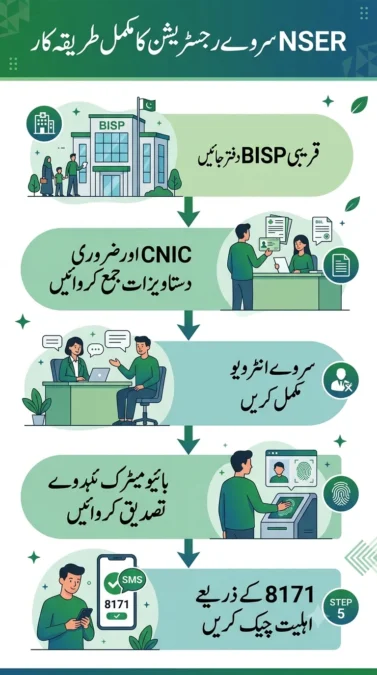
1. Check Your Nearest Registration Office
Visit the nearest BISP Tehsil Office, Tehsil Registration Office, BISP Registration Center, Benazir Registration Center (BRC), or other authorized Registration Center in your Tehsil. Use the Official BISP Directory, BISP Website, Official Contacts, BISP Updates, Office Timings, and Local Locations to find the correct Local Office.
2. Prepare Required Documents
Carry all Original Documents, including your Computerized National Identity Card (CNIC), Original CNIC, Form-B, Children Documents, Household Utility Bills, Electricity Bills, Gas Bills, Proof of Address, and Address Proof for CNIC Verification and Address Verification.
3. Visit the Information Desk
Upon arrival, go to the Primary Information Desk or Information Desk. An Officer will guide a Previously Surveyed applicant or New Applicant regarding NSER Registration, New Registration, Dynamic Registration, and Free Registration.
4. Complete Registration Desk Formalities
Proceed to the Registration Desk, where a Data Entry Operator will begin the Registration Process and create or update your record in the National Socio-Economic Registry (NSER)
5. Attend the Survey Interview
During the Data Entry Interview and Interview Process, answer all Survey Questions with Truthful Answers. You will be asked about Monthly Household Income, Employment Status, Housing Structure, Household Information, Family Information, Applicant Information, Household Expenses, and Utility Expenses.
6. Verify Your Information
Your details are checked through NADRA and the NADRA Database. This stage includes Beneficiary Verification, Eligibility Verification, Income Verification, Utility Verification, and the overall Verification Process.
7. Receive Your Registration Token
After Survey Completion, you will receive a Registration Token, Printed Token, Token Receipt, Registration Receipt, or Tracking Number. Keep it safe for Registration Tracking.
8. Wait for Evaluation and Eligibility Review
Your information is added to the NSER Database for Database Inclusion and Inclusion in Database. Authorities review your Socio-Economic Data, Household Records, Family Registration, and Household Registration through Data Evaluation, Poverty Assessment, and the Proxy Means Test.
9. Get SMS Confirmation
Once processing is complete, you may receive an SMS Confirmation or Official Confirmation SMS. If needed, you can contact the Program Helpline for updates.
10. Check Final Eligibility Status
After Household Qualification and Eligibility assessment, eligible families may be considered for Government Assistance through Social Programs and Social Welfare Programs under the Benazir Income Support Programme (BISP) and related BISP Survey initiatives.

CM Punjab Asaan Karobar Loan 2025: Apply for 0% Interest
Exciting News: CM 3 Marla Plot Scheme 2025 The CM Punjab Asaan Karobar Loan 2025 is a complete guide to interest-free business financing designed to help entrepreneurs across the province. This flagship initiative by the Government of Punjab aims to...
Required Documents for NSER Registration
Before starting NSER Survey Online Registration under the National Socio-Economic Registry through the Benazir Income Support Program (BISP), make sure you have the following documents ready:
- Valid Computerized National Identity Card (CNIC) that is fully verified, unexpired, and issued by NADRA.
- B-Forms (CRC) or Child Registration Certificates for all children and dependent children.
- Family B-Forms to verify family records and household information.
- Household Details, including your monthly income, monthly expenses, and asset ownership information.
- A complete checklist of required documents to ensure smooth processing at your local BISP Tehsil Office or registration center.
- Personal and family information that the primary applicants must provide during registration.
- The female head of the family, whether married, widowed, or divorced, should be present with all correct documents during the application process.
Additional Documents (If Applicable)
Depending on your specific situation and program requirements, you may also need the following additional documents:
- School or College Admission Slip for Benazir Taleemi Wazaif and other educational stipends.
- A slip showing the child’s class, school name, and verification by a teacher.
- A Disability Certificate for those applying under special circumstance categories.
- Any certificate or supporting document recognized by the government for eligibility verification.
Who is Eligible for NSER Survey?
The NSER survey is designed for Every Pakistani Household and aims to cover the entire population through door-to-door survey activities and dynamic surveys. In my experience, many unregistered families and missing families who were left out of previous surveys can still update their records through designated registration centers. The survey gives special attention to vulnerable groups, including low-income families, widows, senior citizens, and people with disabilities, while also considering a family’s socio-economic status to build an accurate national database for every Pakistani Household.
To get a household surveyed, applicants should visit a local center with a valid CNIC or Computerized National Identity Card of the female head of the family, along with B-Forms, Child Registration Certificates, and records of dependent children as part of the required documents for survey participation. It is important to understand that taking part in the survey does not guarantee support; instead, the NSER survey calculates a poverty score, PMT score, and eligibility score to determine program eligibility. Eligible households with a low PMT poverty score and monthly income below Rs. 25,000 may qualify for financial assistance, cash transfers, government funds, BISP, or Ehsaas after verification, online verification, survey completion, and eligibility tracking through the 8171 Web Portal for their household.
What is the PMT Score in the NSER Survey?
The PMT Score (Proxy Means Test) is a digital measurement used in the NSER (National Socio-Economic Registry) to help the Government of Pakistan perform a scientific assessment of a family’s financial standing, welfare status, and overall economic status. During the socio-economic assessment, each household is reviewed through survey data collected for beneficiary identification and welfare eligibility. In my experience helping people understand the registration process, many applicants think only self-reported income matters, but the calculation actually considers several proxies that provide a broader picture of family wealth and qualification criteria for government welfare, cash transfer initiatives, and the Benazir Kafaalat Programme.
The score is measured on a scale from 0 to 100, where a lower score generally reflects greater poverty and vulnerability, while a higher score indicates better financial stability. For accurate poverty measurement, vulnerability assessment, and financial evaluation, the system reviews factors such as household size, education levels, employment status, housing conditions, ownership of assets, livestock, land, and electronic appliances. These details help determine a household’s position and support fair distribution of welfare programs through the NSER system.

Latest BISP 8171 Payment Update 2026
The Benazir Income Support Programme (BISP) continues to provide financial assistance to eligible families across Pakistan. According to the latest BISP 8171 payment update, payments are being released in phases after successful verification of beneficiaries. Eligible families should check their...
Required PMT Score for BISP Eligibility
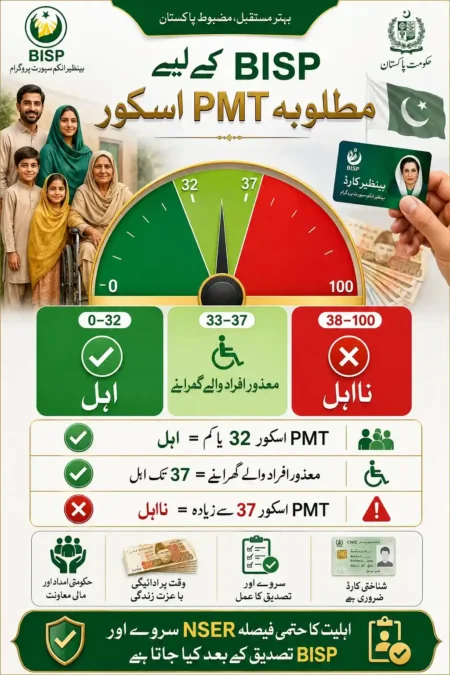
To qualify for the Benazir Income Support Programme (BISP), your PMT (Proxy Means Test) score must be 32 or below. If the household includes a differently-abled person, the PMT cut-off score is increased to 37 as an extended score for assistance. During the NSER survey, every household undergoes a household assessment, household evaluation, and registration evaluation based on household data, registry data, and the survey record. This process determines eligibility, payment eligibility, and overall programme qualification under the assistance programme.
Beyond the score, other essential criteria and baseline conditions must be fulfilled. The registered applicant should be an adult female, adult woman, mother, widow, or divorced individual with a valid CNIC, completed through CNIC verification and applicant verification. The family must have household registration in the NSER Registry (National Socio-Economic Registry), where it is registered, evaluated, and included in the socio-economic survey and proxy means assessment. A Dynamic Survey, regular survey update, dynamic update, and record update keep the NSER record updated within the last two years to avoid payment blockages. This helps maintain registration status, beneficiary registration, registry enrollment, beneficiary eligibility, eligibility requirements, assistance criteria, and accurate records in the socio-economic registry for every female beneficiary supported by the support programme through ongoing survey registration.

Benazir Taleemi Wazaif 2026
Imagine your child sitting at home not because they don’t want to learn, but because school fees are simply out of reach. That’s the reality for millions of families across Pakistan. The Benazir Taleemi Wazaif 2026 was created exactly for...
Difference Between Old and Dynamic Survey
| Aspect | Old / Static Survey | New Dynamic Survey |
| Survey Type | Old survey, static survey | Dynamic survey |
| Registration Method | Periodic registration through massive door-to-door sweeps | On-demand registration through walk-ins |
| Data Collection | Data collection was done by survey teams during specific sweep campaigns | Data collection can be updated at any time through local registration facilities |
| Process | Long and fixed process conducted after several years | Continuous and flexible process available throughout the year |
| Accessibility | Accessibility and access were limited to areas reached during survey campaigns | Anyone can visit local centers, BISP centers, NADRA centers, or a registration center |
| Updates | Infrequent updates and data updates | Continuous updates and real-time updates |
| Information Accuracy | Information often became outdated before the next survey cycle | Records remain current through regular update information facilities |
| Socio-Economic Changes | Socio-economic status changes were not recorded quickly | Changes in socio-economic status can be updated promptly |
| Data Structure | Created a static snapshot with fixed data that remained fixed | Maintains an adaptable and regularly updated database |
| Cost | Costly, expensive, and considered an expensive survey model | Highly cost-effective and a cost-effective survey approach |
| Government Spending | Required repeated large-scale operations and increased expenses | Reduces unnecessary spending by updating records only when needed |
| Disaster Handling | Required resurveying after emergencies | More shock-responsive and useful for disaster response in disaster-affected areas and other affected areas |
| Flexibility | Low flexibility because data remained unchanged until the next survey | High flexibility with continuous and continuously managed updates |
| Main Feature | Relied on a fixed method and survey cycle | Key feature is real-time registration and updating capability |
Common Reasons for NSER Registration Rejection
Having worked closely with families trying to get enrolled in the Benazir Income Support Programme (BISP), I have seen how frustrating it feels when registrations get rejected without a clear explanation. The National Socio-Economic Registry (NSER) uses a Proxy Means Testing (PMT) system that calculated a score for every household based on specific factors like assets, vehicle ownership, utility bill thresholds, and overall poverty status. A valid and updated Computerized Identity Card (CNIC) is not optional — it is a hard requirement for the program. Here are the actionable and specific reasons your NSER survey application may be denied:
1. High PMT Score The standard PMT cut-off is 32, but families that include a differently-abled person get an eligibility threshold of 37. If your calculated score exceeds this limit, your registration is denied automatically.
2. NADRA Record Mismatches The survey cross-checks your submitted details including names, ages, and marital status directly against NADRA records. Any discrepancies or mismatches between your stated details and your Computerized Identity Card (CNIC) trigger rejection.
3. International Travel History Frequent overseas trips or any international travel history flags your household as having a higher socio-economic status, pushing you above the standard threshold.
4. Vehicle and Property Ownership The Registry cross-checks assets, and owning multiple vehicles or properties will disqualify your household automatically.
5. Government Employment or Pension If any member of your immediate family holds government official employment or receives a pension as a government servant, your household is no longer considered eligible for financial assistance.
6. High Utility Bill Thresholds Unusually high monthly electricity, gas, or telecommunications utility bill amounts push households above acceptable thresholds and get them excluded from the program.
7. Lack of Vulnerable Groupings The NSER weights inclusion heavily toward vulnerable groupings such as elderly dependents, widowed members, dependent children, and households with a differently-abled person. If your household lacks these vulnerability factors, you may be excluded from eligible groupings regardless of your actual poverty level.

BISP 13500 Payment Status Check 2025 – December Updated
The Benazir Income Support Programme (BISP) provides financial assistance to families in Pakistan who qualify for support. In December 2025, beneficiaries of the BISP can check their 13,500 payment status through various official channels. This guide will help you easily...
How to Update NSER Survey Information
To update your National Socio-Economic Registry (NSER) information in Pakistan, which is used for the Benazir Income Support Programme (BISP), you need to visit your nearest BISP Tehsil Office. The NSER data is updated through a dynamic survey system, which means the information cannot be fully updated online and requires an in-person visit for verification and corrections.
Benefits of Completing NSER Survey
Once registered, low-income households gain Direct entry to multiple welfare benefits that can genuinely ease immediate crises:
- Education Support: Children in qualifying families become eligible for Stipends through Waseela-e-Taleem, which covers school costs and removes barriers to Education, ensuring every child can attend without financial worry.
- Health & Crisis Assistance: Families facing health Shock—whether from illness or earthquakes and floods—can access Assistance without lengthy delays, receiving medical support when vulnerability strikes hardest.
- Cash Transfers & Emergency Relief: Parents managing unemployment or unexpected financial hardship receive cash Transfers and Interest-Free Microloans to bridge immediate gaps, with Food cards and Subsidized healthcare coverage providing ongoing relief.
- Rapid Processing: The capital for these Top-ups isn’t bureaucratic—it’s rapid, often processed within 5 to 12 days, ensuring families don’t wait through endless applications or proxy means tests.
- Automatic & Recurring Support: Stipends continue automatically once you Qualify, without demanding endless paperwork, while recurring benefits Unlocks sustained relief for inflation, unemployment, and economic pressures.
- Integration Across Systems: This Integration of funding across federal and provincial systems, combined with Data-Driven Vulnerability assessment, ensures that infrastructure plans, school projects, housing support, land ownership programs, and disability services actually reach families facing the deepest need.
NSER Survey vs 8171
The NSER Survey is a data-gathering process where BISP collects your household information, while 8171 is just a verification tool — an official SMS service and online portal — that lets you check your eligibility using your 13-digit CNIC. One builds your profile in the national database, the other simply lets you read it.
| NSER Survey | 8171 | |
| What it is | A data collection questionnaire | A communication tool and official web portal |
| Purpose | Records your income, family size, and assets to assign poverty scores | Lets you check eligibility and track payment status |
| How it works | A mobile registration team or Tehsil Office visit fills your NSER data into the National Socio-Economic Registry | Done online by sending your 13-digit CNIC to 8171 via SMS |
| What it evaluates | Your socio-economic status to evaluate whether you qualify | Pulls existing records from the national database |
| Outcome | Determines eligibility for cash transfers under the Benazir Kafalat program | Shows your current registration and payment status |
| Action required | Visiting a BISP office or meeting a mobile registration team | Simply sending your CNIC to 8171 |
What 8171 Actually Does (And Why People Confuse It with NSER)
Most people I have talked to assume that sending their 13-digit CNIC to 8171 means they have completed their registration — but that is not how it works. 8171 is simply a communication tool, an official SMS service and online portal that lets you check your eligibility for government aid, track your payment status, or verify whether your household already exists in the national database. You are not enrolling in anything by sending a message — you are just querying what is already recorded.
Where NSER Survey Fits Into the Picture
The real process starts with the NSER Survey, which is a structured data-gathering exercise carried out by BISP through either a Tehsil Office visit or a mobile registration team that comes to your area. A trained officer fills out a detailed questionnaire covering your income, family size, and assets — this entire data collection effort feeds into the National Socio-Economic Registry, where your NSER data is stored as permanent records. Based on this, the system uses an algorithm to evaluate your socio-economic status and assign poverty scores, which then determine whether you qualify for cash transfers under the Benazir Kafalat program.
Common Problems and Solutions
Outdated Household Information: Over time, family structures, locations, and economic situations change, which can render old registry data invalid for determining your Poverty Means Test (PMT) score. The solution is to visit a local NSER registration center to update your demographic details (like marital status, the death of a member, or adding new children) after two years without waiting for a new government survey.
Exclusion and Inclusion Errors: Vulnerable families are sometimes missed or left out during previous door-to-door surveys (exclusion error), while ineligible individuals get registered (inclusion error) in the National Socio-Economic Registry (NSER) database. To fix this, you can now register on-demand by visiting your local Benazir Tehsil Office or official Registration Centers to ensure your household is correctly enrolled for welfare support as genuine BISP beneficiaries.
Beneficiaries frequently struggle to withdraw cash due to unmatched fingerprints or system errors at Point of Sale (POS) agents. To solve this, ensure your fingerprint data is updated and clear at a local NADRA office; if biometric verification fails during a withdrawal, use designated HBL Konnect retail shops or ATMs that align with BISP protocols.
Missing SMS and Payment Delays: Recipients often fail to receive critical SMS notifications regarding their eligibility status or cash disbursements, leading to anxiety over payment delays. The best solution is to always use the official 8171 Web Portal to check your program funds, and strictly avoid unverified third-party apps to prevent data theft.
CNIC and Document Issues: Expired Computerized National Identity Cards (CNICs) or unverified B-Forms for children cause an immediate suspension of your funds. Always keep your identification documents updated through NADRA, and ensure the female head of the household is in possession of an active, valid CNIC before visiting a Benazir center for registration or update requests.
Conclusion
The National Socio-Economic Registry (NSER) survey remains the foundational gateway for accessing vital social safety nets in Pakistan, including the Benazir Income Support Programme (BISP) and the 8171 kafalat initiatives. The transition to the NSER Dynamic Survey model in 2026 ensures that eligibility tracking, proxy means test (PMT) score calculations, and beneficiary registration remain accurate, transparent, and shock-responsive. By checking registration status online via the 8171 web portal or verifying records at a local BISP Tehsil office, deserving families can secure critical financial assistance, Taleemi Wazaif educational stipends, and emergency relief packages. Keeping your household data and NADRA biometric verification updated within the mandatory window is essential to avoid payment blockages and maintain uninterrupted access to government welfare programs.