
Gold Trading in Pakistan: How to Start & Invest

Most people think gold trading is simply about buying and selling but practitioners who’ve spent real time in this space know it operates more like a living system of value preservation tied deeply to economic instability and cultural memory. In Pakistan, where the Pakistani Rupee has repeatedly faced currency devaluation, the decision to invest in gold is less about speculation and more about financial security, a pattern passed through families across generations. What separates informed participants from beginners is understanding that gold trading online demands both detailed procedures and awareness of potential risks before committing capital. Whether you approach it through PMEX, licensed platforms, or spot trading, the entry point matters less than the discipline behind it.
The investment strategies that actually deliver maximum profit aren’t built on luck they’re built on choosing between futures trading, options trading, and physical formats like gold coins or bullion with clear-eyed awareness of your objectives. Professionals at firms like BABA Equities and Abbasi and Company have long emphasized that clients who treat gold as an investment option rather than a reactive hedge consistently extract best possible value from market cycles. Gold trading services backed by a team of experts with longstanding reputation and excellence give investors a real edge — because in this market, access to informed gold trading decisions, profit strategies, best brokers, and secure trading options determines who captures prosperity and who merely watches it pass.
What is Gold Trading?
Contrary to the popular image of vaults and physical bars, most active gold trading in Pakistan today happens through contracts and derivatives on trading platforms — instruments designed specifically to let participants capture short-term possibilities from price movement without ever touching actual gold items like jewelry or bars. The real value of understanding this distinction is that it reframes gold not as a static asset but as one of the most actively traded precious commodities in global markets, where inflation, interest rates, central bank policies, and the US dollar all pull pricing in competing directions through an inverse correlation that experienced traders monitor closely.
What makes online trading platforms genuinely powerful for participants seeking to control risk and diversify portfolios is their ability to reflect geopolitical turmoil and market stress in real time — conditions that historically validate gold’s role as a haven. Practitioners who’ve navigated multiple market cycles in Pakistan understand that tracking the online gold rate isn’t just a habit — it’s the foundation of every disciplined entry and exit. Physical storage concerns become irrelevant when you’re operating through regulated trading platforms, which is precisely why derivative-based gold trading continues to attract both institutional and retail traders looking for profit through investment efficiency rather than ownership.
Why You Should Invest in Gold ?
There’s a reason experienced investors in Pakistan don’t treat gold as a backup plan — they treat it as structural. When the PKR slides against the US dollar, those holding physical gold or digital gold don’t scramble; they simply watch their position appreciate. This isn’t coincidence — it’s the inherent worth of an asset with intrinsic value that paper currency structurally cannot replicate. Pakistani households have understood this through lived experience long before modern finance gave it vocabulary: gold jewellery purchased for weddings and festivals has consistently served both cultural significance and silent capital protection.
The argument for online gold trading goes beyond the safety net it provides when the rupee depreciates. Liquidity is a factor that gets underestimated — unlike real estate, both digital gold and physical gold positions can be exited with speed. Constant Demand driven by Pakistani traditions creates year-round demand that supports long-term value in ways that purely speculative assets cannot match. Meanwhile, Global worth tied to worldwide markets means Pakistani investors aren’t limited to local markets — gold’s pricing reflects geopolitical turmoil, interest rates, and US dollar dynamics simultaneously. For those navigating financial instability, this Hedge against inflation characteristic, combined with Accessibility across formats from jewellery to app-based digital gold, makes it a dependable foundation for portfolio diversification. The psychological dimension matters too — financial security in an environment of currency volatility and inflation is not a luxury but a strategic necessity for Pakistanis who understand what gold and silver have historically delivered as popular investment options.
Is Gold Trading in Pakistan Legal and Regulated?
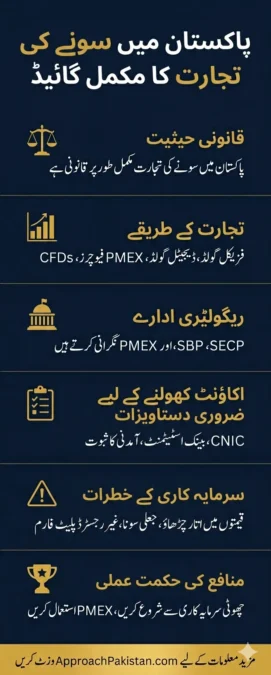
One of the most practical questions any serious participant should resolve before entering this space is whether the framework protecting their capital actually has teeth — and in Pakistan, the answer is yes, provided you operate through the right channels. The Securities and Exchange Commission of Pakistan (SECP) oversees investment companies and brokers, the State Bank of Pakistan (SBP) governs exchange rules and banking regulations, and the Pakistan Mercantile Exchange (PMEX) serves as the primary regulated arena for futures and commodities trading. This three-body structure creates layered accountability that licensed brokers and certified brokers must operate within — meaning KYC (Know Your Customer) protocols, account verification, and account authentication are not optional checkboxes but legal requirements embedded into the process of accessing digital gold or futures trading.
Where practitioners consistently see capital eroded is through unlicensed schemes that bypass this framework entirely — unauthorized programs operating outside regulatory bodies that attract participants with promises of returns no regulated structure would credibly offer. The distinction between financial companies with verifiable investment firms standing and unvetted operators isn’t always visible at the surface level, which is why experienced participants treat SECP registration and PMEX licensing as non-negotiable filters. High returns promised by unregulated operators should immediately signal risk — large rewards in commodities trading are earned through strategy and market knowledge, not through platforms that avoid exchange laws and banking oversight. Every certified broker operating legitimately welcomes scrutiny; the ones who don’t are the ones who should be avoided entirely.
Where Can You Do Online Gold Trading in Pakistan?
The landscape of gold investment in Pakistan is wider than most new participants realize — and each format carries distinct benefits and risks that don’t always align with conventional wisdom. Physical Gold in the form of coins, bars, and jewellery remains the most culturally valued and widely available entry point, but practitioners who’ve dealt with storage risks, making charges, and purity issues firsthand know it demands more operational discipline than it appears. Digital Gold offered through banks and fintech companies via mobile apps solves the storage problem while providing transparent pricing and the ability to invest in small amounts — though limited platforms and the need for internet and account setup create friction for some users.
Gold Savings Accounts offered by select banks in Pakistan allow deposits to track the price of gold through regulated financial institutions, offering convenience at the cost of potential management fees and restricted withdrawal flexibility. For participants seeking more sophisticated exposure, Trading Gold CFDs — Contracts for Difference — provide access to gold price movements without the need to hold physical gold, offering flexibility to profit from both rising prices and falling prices with global exposure, though the complex structure carries meaningful risk of capital loss and suits experienced participants rather than first-timers. The Pakistan Mercantile Exchange (PMEX) operates as the backbone of regulated futures exchange activity in the country, offering standardized contracts tied to worldwide pricing through a transparent, safe platform. A reliable broker connected to this exchange provides user-friendly interfaces, real-time online gold rate charts, market data, and access to broader commodities including platinum and crude oil — making it a strong foundation for novice traders building out their first gold trading positions in Pakistan.
How to Invest in Gold in Pakistan ?
In Pakistan’s current environment of unpredictable economic times, the practitioners who consistently build long-term value from gold trading aren’t necessarily the ones with the most capital — they’re the ones who treat the online gold rate as a daily data point rather than an afterthought. Monitoring foreign markets and the PKR/USD exchange rate before any purchases is the difference between strategic entries and reactive ones that compound losses. Whether your format is Physical Gold — jewelry, coins, or bars from reliable vendors — or Gold Trading Online for ease and liquidity, the investment principle is identical: know the price environment before you commit. Digital/Commodity Trading through commodity markets and licensed brokers adds another layer of online gold trading access, but each format demands honest assessment of your risk tolerance, objectives, and financial constraints before you select between physical, PMEX, CFDs, digital, or savings account routes.
What separates durable investing portfolios from fragile ones is execution discipline at every stage. Working with banks, registered brokers, or reputable jewelers rather than unregulated marketplaces eliminates the gold fraud exposure that costs participants dearly in informal channels. Once you’ve completed KYC and identity verification as a legal requirement, fund through bank transfers, PayPak, or accessible local services and resist the impulse to over-commit early — small amount entries allow you to understand market behaviour before scaling. For medium-term and long-term investments, tracking the online gold rate in Pakistan and identifying an exit point with the same discipline applied at entry is what separates profitable participants from those who hold too long. Whether managing physical gold in a safe location or monitoring digital holdings through secure apps, the underlying principle is perseverance, thorough investigation, and treating every position as part of a safe and successful broader gold trading online strategy — one that values tangible assets alongside flexibility without letting either bias override financially stable decision-making.
Steps to Open a Gold Trading Account
Opening a gold trading account is a process most participants overcomplicate in their heads but find straightforward once they’ve gathered the right documents. The standard requirements — Valid CNIC, Registered Mobile Number tied to the Account Holder, a Valid Email Address, IBAN proof in the form of a Cheque copy or Bank Statement, a Salary Slip confirming Source of Income, and a current Bank Statement — exist not as bureaucratic hurdles but as the framework that keeps regulated platforms clean and account holders protected. You can complete this either through a physical office visit or entirely online, after which the application moves through verification and your access is confirmed.
For those specifically entering through PMEX, the process runs through a licensed broker who connects you to the Pakistan Mercantile Exchange infrastructure. KYC verification using your CNIC and bank details is mandatory, and once your deposit clears, you’re positioned to begin gold futures trading online — a format that gives you exposure to market movement without the logistical overhead of managing physical holdings. Practitioners who’ve been through this process recommend treating the onboarding stage as an education in itself: the questions the broker asks, the compliance checks embedded in KYC, and the structure of the gold trading account setup all reveal how seriously a platform takes its regulatory obligations — which tells you a great deal about whether your capital is in capable hands.
Gold Prices in Pakistan: Market Trends and Local Dynamics
Understanding what actually moves gold prices in Pakistan requires tracking multiple factors simultaneously — and practitioners who treat this as a single-variable problem consistently misread the market. Global rates expressed as XAU/USD set the foundational base price that everything else adjusts around, but the PKR/USD exchange rate introduces a local multiplier effect: when the rupee weakens, the local gold price climbs independently of what international markets are doing. This dynamic means Pakistani participants are effectively managing two market exposures at once — global commodity movement and domestic currency performance — which is why monitoring daily gold prices through reputable financial websites is a non-negotiable discipline rather than an optional habit.
Beyond macro factors, local demand patterns driven by weddings, festivals, and cultural events create seasonal pricing pressure that experienced participants anticipate rather than react to. City differences between Karachi, Lahore, and smaller markets mean the same underlying commodity can carry different transactional costs depending on geography. Retail markup applied by jewellery stores — layering making charges and profit margins over the spot price — ensures that physical buyers rarely access pure market pricing. Tracking these trends consistently and incorporating them into your investments decision-making process is what separates participants who understand gold in Pakistan from those who are simply guessing at prices.
Risks and Costs of Gold Investment
The risks embedded in gold investment are rarely catastrophic in isolation — but they compound quickly when participants ignore them systematically. Price volatility in the short-term can produce price swings severe enough to trigger panic exits at exactly the wrong moment, particularly for those who entered without a defined opportunity cost framework that acknowledges gold’s positioning relative to stocks and other investments. Storage and security requirements for physical gold demand a safe environment that many participants underestimate — informal arrangements that seem adequate quickly become vulnerabilities. Meanwhile, counterfeit risks in unverified supply chains remain real, making access to trusted companies and licensed jewellers not a preference but a protection mechanism.
The practical response to these risks isn’t avoidance — it’s structured mitigation. To diversify investments across formats rather than concentrating in a single channel reduces exposure to any one failure point. Taking time to verify purity at acquisition, and consistently track performance of your holdings against both local and international benchmarks, converts reactive risk management into proactive portfolio governance. Practitioners who’ve built durable positions in this space treat high returns as a byproduct of discipline rather than a starting expectation — and that mindset shift alone eliminates the majority of costly mistakes that erode gold investment value over time.
Final Checklist for Investing in Gold
Before committing capital, practitioners who’ve navigated multiple cycles in Pakistan’s commodity markets consistently return to the same foundational filters. Choosing the right gold investment method upfront — physical, digital, futures, or savings-linked — eliminates a category of mistakes that no amount of subsequent strategy can correct. Verifying the licenses held by your brokers, banks, or companies before transfer of funds is non-negotiable; regulatory standing is the clearest available proxy for operational integrity. Clarifying storage and security requirements specific to your chosen format ensures you’re not discovering logistical gaps after your position is already live.
Tracking prices of gold consistently — not just at entry but throughout the holding period — keeps your decision-making anchored to market reality rather than assumption. Starting with small investments and scaling deliberately rather than committing fully at the outset is a discipline that every experienced practitioner endorses, not because the market can’t be trusted, but because understanding how your chosen platform, broker, and format behave under real conditions requires time that only live exposure provides.


