Economic Factors Affecting Gold Prices in Pakistan
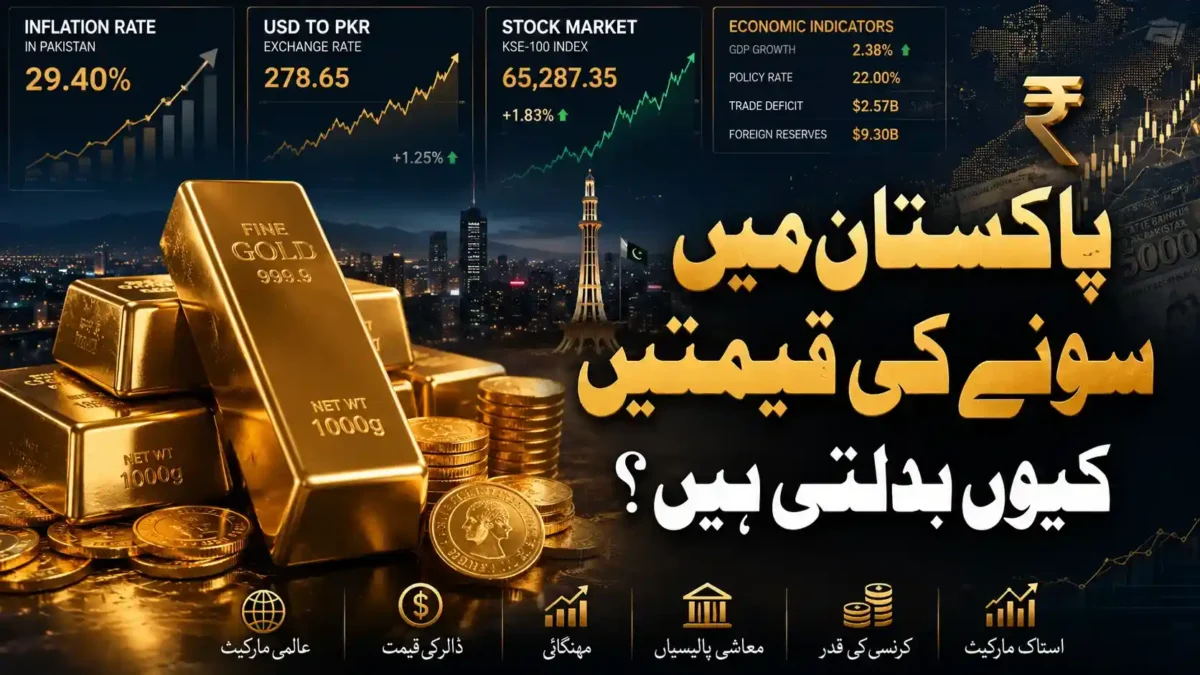
Gold prices in Pakistan are not set randomly. They move due to several economic factors that influence both local and international markets. Since Pakistan depends heavily on imported gold, changes in the economy directly affect gold prices in Pakistan.
Understanding these factors helps investors, jewelers, and everyday buyers make better decisions.
Inflation and Cost of Living
One of the biggest drivers of gold prices is inflation. When the consumer price index (CPI) rises, the value of money falls. People then turn to gold to protect their savings.
- Higher inflation increases gold demand
- Gold is seen as a hedge against rising prices
- Long-term inflation pushes gold prices upward
PKR Depreciation and Exchange Rate
The Pakistani rupee (PKR) plays a crucial role in gold pricing. Gold is traded globally in US dollar (USD).
When PKR depreciation happens:
- Gold imports become expensive
- Local tola rate increases
- Jewelry becomes less affordable
Even if global gold prices remain stable, a weaker PKR can raise prices in Pakistan.
Role of State Bank of Pakistan and Interest Rates
The State Bank of Pakistan controls SBP monetary policy, including interest rates and the discount rate.
- Higher interest rates reduce gold demand
- Lower rates encourage investment in gold
- Changes in money supply affect inflation and gold prices
Gold becomes more attractive when returns on savings and bonds are low.
Global Gold Market Influence
Pakistan closely follows the international gold market. Prices are based on the spot gold price set at markets like the London Bullion Market (LBMA) and COMEX.
Global factors include:
- Gold ounce price fluctuations
- Demand from major economies
- Market speculation and futures trading
Any global price movement is quickly reflected in Pakistan.
Economic Uncertainty and Geopolitical Risk
During times of economic uncertainty, people buy gold as a safe haven asset. Events like the Russia-Ukraine war or Middle East conflict raise global fears.
Effects include:
- Higher investment demand
- Increased price volatility
- Sudden spikes in gold rates
Gold performs well when confidence in the economy is low.
Trade Deficit and Import Dependency
Pakistan has high import dependency, which impacts gold pricing.
- Rising trade deficit increases pressure on PKR
- Higher import bill weakens currency
- Gold imports become more costly
A growing current account deficit also affects foreign exchange stability.
Energy Prices and Cost-Push Inflation
Rising oil prices and energy prices increase transportation and production costs.
This leads to:
- Cost-push inflation
- Reduced purchasing power
- Increased gold demand as protection
Higher fuel prices indirectly push gold rates higher.
Taxation Policy and Smuggling
Government taxation policy influences gold prices. Taxes like sales tax, withholding tax, and import duties increase costs.
As a result:
- Gold smuggling increases
- Informal pricing becomes common
- Market transparency declines
Smuggling disrupts supply and pricing stability.
Investment and Jewelry Demand
Gold demand comes from two main sources:
- Investment demand for wealth preservation and hedging
- Jewelry demand for cultural and wedding purposes
During economic stress, investment demand rises, pushing prices up.
Remittances and Capital Flows
Strong remittances and capital inflows support PKR stability.
- Stable currency controls gold prices
- Capital flight weakens PKR
- Economic confidence reduces gold demand
Foreign exchange health directly affects gold rates.
Conclusion
The economic factors affecting gold prices in Pakistan are deeply interconnected. Inflation, PKR depreciation, interest rates, global gold prices, and economic instability together shape the gold market. In 2025 and 2026, gold remains a key tool for financial safety in Pakistan, especially during uncertain economic conditions.