CDA Takes Action Against Developers for Chopping Trees in Islamabad — What It Means for the Capital’s Green Future
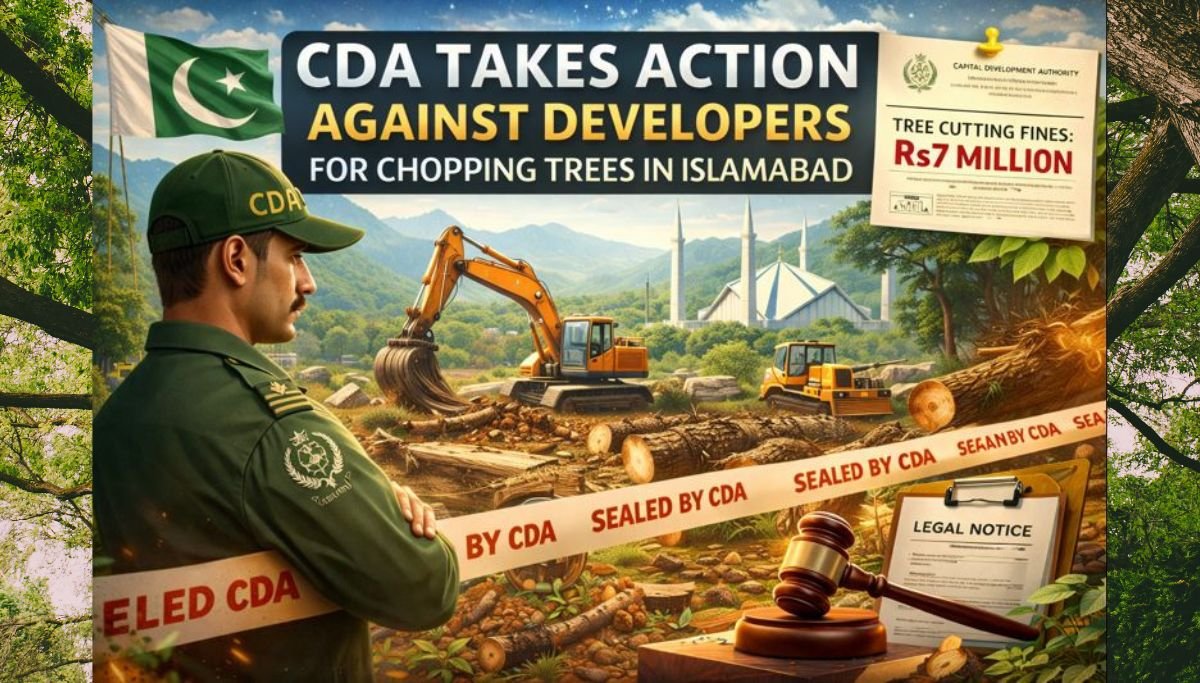
Islamabad, long known as Pakistan’s green capital, is now at the center of a heated environmental and legal debate. In January 2026, the Capital Development Authority (CDA takes action against developers for chopping trees in Islamabad) after reports surfaced of illegal tree cutting in forestland near Bhara Kahu.
This move has sparked discussion among city residents, environmental groups, and the courts. The issue is now more than just about trees — it taps into broader concerns about urban planning, ecology, development, and law enforcement. check official site
What Happened — CDA Cracks Down on Tree Cutting
On January 21, 2026, CDA’s Environment Wing took decisive action against private developers accused of illegally clearing forestland in the RF‑8 Bhara Kahu area of Islamabad. Officials found that more than 10 kanals of forest were leveled after trees were chopped down without authorization.
CDA spokesman Shahid Kiani said the authority confiscated machinery used in the activity and halted further work immediately. As part of enforcement, a fine of Rs7 million was imposed against those responsible for the removal of nearly 40 trees and more than 100 shrubs.
An FIR was registered at the Bhara Kahu police station, and cases were moved to court for recovery of fines and further legal action.
Where the Incident Took Place
The reported illegal tree cutting occurred in an area identified as reserved forest land. CDA’s official land records, dating back decades, clearly demarcate this land as part of Islamabad’s protected forest belt — making the developers’ actions not just controversial but arguably unlawful. approachpakistan
Meanwhile, officials stressed that the agency maintains records of forest land dating as far back as the early 1900s, and that boundaries are well established.
Why the Issue Matters — Islamabad’s Green Identity Under Threat
Islamabad isn’t just another city — it was designed with greenery as a core principle. Its master plan, green belts, wide boulevards, and forested hills give it a unique identity among Pakistan’s major urban centers.
Trees here:
- lower urban heat,
- filter air pollution,
- protect soil from erosion,
- provide habitat for wildlife.
Losing them isn’t merely aesthetic. It affects everything from residents’ health to climate resilience.
When residents saw heavy machinery on forest land, the shock wasn’t just about the loss of trees — it was about losing part of the city’s soul.
Court Steps In — IHC Halts All Tree Cutting
The Islamabad High Court (IHC) entered the picture soon after the CDA’s action became public.
In response to a petition filed under Article 199 of the Constitution, Justice Khadim Hussain Soomro ordered an immediate halt to tree‑cutting activities in the federal capital until the next hearing, scheduled for February 2, 2026.
The court also directed the CDA, Pakistan Environmental Protection Agency (Pak‑EPA), and the Ministry of Climate Change to submit detailed reports outlining:
- how many trees were cut,
- where and why they were removed,
- if proper environmental impact assessments were conducted.
The petition argued that large‑scale tree cutting violated the Pakistan Environmental Protection Act, 1997, and Islamabad’s master plan — and that the practice was contributing to environmental degradation.
Legal Backdrop — Pakistan’s Environmental Laws
Under Pakistan’s environmental framework, trees on public land, especially in protected forests or green belts, cannot be removed without permission and environmental clearance. The Environmental Protection Act, along with Islamabad’s specific planning laws, requires responsible authorities to follow procedures that protect green cover and public interest.
The IHC’s intervention shows that courts are ready to enforce these protections when violations are evident.
Conflicting Narratives — Public Health vs. Development Concerns
Part of the broader debate stems from public health and planning issues.
Federal officials, including the Minister of State for Interior, have defended some tree removal efforts by saying that certain species — especially paper mulberry trees — contribute to severe pollen allergies. Proponents argue that removing these trees serves a legitimate public health purpose.
At the same time, environmental groups like WWF‑Pakistan dispute the narrow framing of this argument. They say field assessments show that tree removal goes beyond allergy management. According to WWF, clearing took place at sites where infrastructure and development projects are underway, such as road expansions and monument construction areas.
This divergence highlights a critical question: Are authorities balancing public health and development with ecological protection — or sacrificing one for the other?
Environmental Groups Weigh In
WWF‑Pakistan’s assessments suggest that vegetation loss is not limited to specific species but is widespread around areas such as Shakarparian, National Museum precincts, and other key green spaces. The organisation argues that cutting trees without transparent ecological planning may weaken Islamabad’s natural systems and reduce biodiversity.
Their reports also call for clearer impact assessments, independent monitoring, and public disclosure of the species removed versus those planned for replanting.
These perspectives add depth to the ongoing debate and encourage more evidence‑based policy discussions.
Public Reaction — Civic Pride and Concern
Grassroots responses have been strong and vocal. Islamabad residents have long taken pride in the city’s greenery. When trees come down — whether for valid reasons or questionable motivations — social media lights up with debates, photos, and calls for accountability.
Some residents acknowledge allergies and public health concerns. Others express frustration that development sometimes prioritises construction over nature.
A common sentiment is: “We don’t oppose development, but it should not be at the cost of our lungs and future.”
The public reaction indicates a deeper connection to local ecology — one that goes beyond mainstream news headlines.
CDA’s Reforestation and Compensatory Plans
In response to criticism, the government has announced efforts to plant more trees than those removed. The Climate Change Ministry said that for every tree cut, at least three new indigenous trees will be planted across Islamabad.
Officials also pledged transparency, stricter enforcement of environmental laws, and larger tree counts to show positive progress.
This kind of compensatory initiative is essential. Planting strategies, when done well, can help restore cover over years — but they must follow careful ecological and spatial planning.
Can Planting Fully Replace What Was Lost?
- Here’s a simple reality:
- Cutting an old tree takes minutes.
- Growing a mature tree takes decades.
This is why many environmentalists caution that replantation programs need time, consistent watering, biodiversity planning, and community involvement. Otherwise, newly planted saplings risk dying before making an impact.
CDA’s triple plantation plan is ambitious, but its success will depend on long-term follow‑up, monitoring, and protection against vandalism, grazing, or urban encroachment.
Broader Urban Planning Concerns
Beyond the immediate controversy lies a bigger conversation about Islamabad’s future urban planning.
- Cities worldwide face the challenge of balancing:
- housing demand
- infrastructure development
- AND
- environmental sustainability
Islamabad’s strategic plan aims to preserve green belts, forest reserves, and public spaces while supporting economic growth. The current debate brings a test: Can planners, courts, and citizens collaborate to maintain that balance?
The Lessons So Far
So what lessons are emerging from this complex situation?
- Legal oversight makes a difference.
The IHC’s involvement has forced transparency and accountability. - Trees matter to citizens.
Public engagement reflects a genuine connection to green spaces, not just aesthetics. - Development must respect environmental law.
Islamabad’s master plan designates where vegetation should be protected. - Planting trees is not like printing money.
Long-term growth requires care, resources, and ecological understanding.
What Happens Next — The Road Ahead
The IHC will reconvene on February 2, 2026, to review the government’s reports on tree removal and environmental compliance. This hearing will likely clarify:
- whether further tree cutting can resume,
- what disciplines will govern future actions,
- and whether new oversight mechanisms will shape policy.
This case sets a precedent for urban environmental governance in Pakistan. Islamabad’s experience will likely inform how other cities approach tree protection in the face of development pressure.
Final Thoughts — Balancing Progress with Preservation
The fact that CDA takes action against developers for chopping trees in Islamabad signifies a watershed moment for environmental enforcement in the capital. It shows that authorities can — and must — enforce rules when violations occur.
But the larger challenge isn’t just enforcement. It’s about building a shared vision where development and ecology are not seen as enemies but as partners in shaping a city that remains green, healthy, and vibrant for generations.
Islamabad can still set an example for other cities — if green isn’t just a slogan, but a policy commitment.