BISP Ineligible Categories 2026: Who Gets Disqualified?
What is the BISP Appeal Process and Why It Matters
The Benazir Income Support Program (BISP) helps millions of struggling families across Pakistan, but not everyone qualifies. Recently, thousands of families discovered their names removed from the BISP list because they fell into bisp ineligible categories 2026. Understanding why people get disqualified and what you can do about it is crucial in 2026.
This guide explains who cannot receive BISP assistance, the reasons behind disqualification, and steps to take if you believe you’ve been wrongly removed from the program.
[whatsapp_banner]
What is BISP and Why Some People Get Rejected
However, misuse and fake applications forced authorities to introduce stricter filters. Those who don’t meet updated criteria receive disqualification messages and lose access to quarterly stipends.
The BISP specifically targets poor, unemployed, and widowed women who cannot meet basic household needs. The program relies on data from NADRA and the National Socio-Economic Registry (NSER) to identify deserving women and families living below the poverty line.
[kadence_related_post post_id=”2683″]
Major BISP Ineligible Categories in 2026
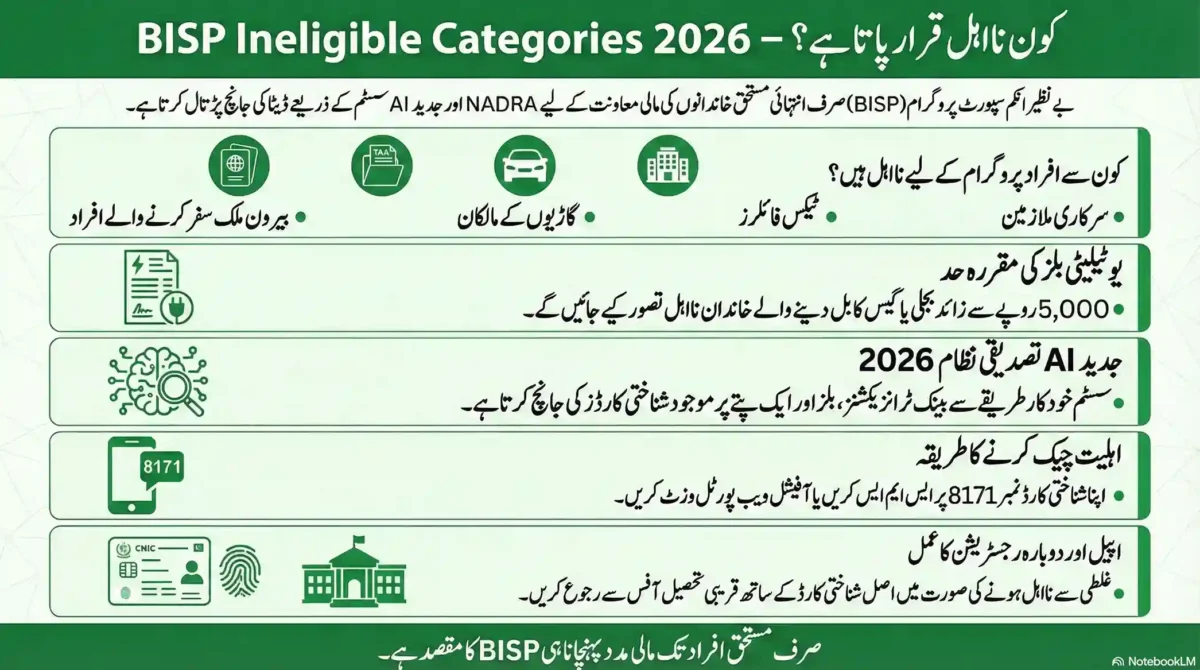
1- Government Employees and Pension Holders
Anyone working in federal jobs, provincial jobs, or semi-government jobs automatically becomes disqualified. Even low-paying government jobs count as ineligible because these individuals receive regular salaries. Similarly, retired persons receiving pension holders benefits cannot claim BISP assistance.
2- Income Tax Filers and Active Taxpayers
If your name appears in the FBR Active Taxpayer List (ATL) or you’ve filed income tax returns, the system considers you financially stable. Being an Active Taxpayer proves you have a steady income source, making you ineligible for BISP.
3- Car and Motorcycle Owners
Families owning car owners or multiple motorcycle owners are considered financially capable. Ownership records from NADRA and excise records reveal vehicle registrations. Owning more than one bike or any car disqualifies the entire household because asset ownership indicates financial stability.
4- Passport Holders with Travel History
Anyone with a passport who has traveled abroad, especially for non-labor purposes, gets disqualified. The system assumes passport holders with travel history abroad can afford lifestyle expenses. However, labor visas for countries in the Middle East may be reviewed separately during re-verification.
5- Monthly Income Above BISP Threshold
Households earning more than Rs. 30,000 to Rs. 40,000 monthly are marked ineligible. The NSER survey data, combined with electricity bill and gas bill records, determines this monthly income level.
6- High Utility Bill Payers
Regular utility bills exceeding certain amounts signal spending power. Here’s how it works:
- Less than Rs. 1,000/month: Likely eligible
- Rs. 2,000 to Rs. 5,000/month: Under review
- Over Rs. 5,000/month: Likely ineligible
High electricity bill or gas bill payments suggest the family can afford more than basic necessities.
7- Business Owners and Shopkeepers
People running registered business owners, shopkeepers, retail shops, kiryanas, or earning as freelancers with bank account records are disqualified. Private company directors also fall into this category because they have visible income sources.
[kadence_related_post post_id=”2704″]
8- Fake Information Providers
Providing fake information during the NSER survey leads to immediate disqualification. Common issues include mismatched CNIC details, wrong household data, and false claims about being unemployed. During re-verification, such cases get flagged as fraudulent information.
7- Beneficiaries of Other Programs
The Punjab government is removing people already receiving support from:
- Ration Card Holders under Punjab Ration Program (receiving food subsidies)
- Ramadan subsidy recipients (who received Rs. 10,000)
- Punjab Housing Scheme beneficiaries (who got Rs. 1.5 million loan)
- PSER Program (Social Economic Relief) participants
- Aghosh Program women (receiving maternal and child health support)
This prevents duplicate benefits and ensures financial aid reaches the most vulnerable families.
[kadence_related_post post_id=”2770″]
How to Check Your BISP Eligibility Status Online
You can verify your eligibility status using these methods:
- SMS Verification: Send your CNIC number to 8171
- Visit the 8171 Web Portal at 8171.bisp.gov.pk
- Go to your nearest BISP Tehsil Office
If you receive a message saying you’re not eligible, you fall into one of the bisp ineligible categories 2026 mentioned above. per month, and you shouldn’t have government employment or significant assets.
[kadence_related_post post_id=”4452″]
Can You Appeal or Reapply for BISP
Yes! If your financial situation changed or wrong information caused disqualification, you can update your NSER data. Visit the registration center or NADRA office with:
- Original CNIC
- Ration Card (if applicable)
- Proof of financial hardship
- Any relevant documents
The re-verification process allows genuine recipients to restore their payments through the appeal process.
[kadence_related_post post_id=”2928″]
Latest Updates in 2026 for BISP Verification
The government introduced AI-based verification systems that automatically detect ineligible individuals using:
- Bank account analysis and transaction history
- Utility bills meter usage trends
- Number of CNIC linked to one address
- Family T-Score via NSER database
These measures improve transparency and accountability while directing resources toward truly needy families.tsApp, ensure photos are well-lit and text is visible.
What to Do If You’ve Been Removed from BISP
Don’t panic—follow these steps:
- Visit your Tehsil Office immediately
- Bring your CNIC and supporting documents
- Request status verification
- Provide proof of current financial hardship
- Avoid waiting too long before filing your review request
Timely action increases chances of payment resume and reinstatement.
Common Mistakes to Avoid When Applying for BISP
- Ignoring official announcements and SMS notification
- Submitting incomplete documents
- Not checking eligibility status regularly
- Relying on unverified social media claims
Stay updated through the 8171 Web Portal and authorized BISP channels..
[kadence_related_post post_id=”4320″]
Conclusion
The bisp ineligible categories 2026 guidelines ensure welfare programs reach Pakistan’s poorest families. While the filters seem strict, they protect the program’s integrity and direct financial aid to those who genuinely need it.
If you’ve been disqualified, check whether your situation truly changed or if there’s been an error. Use the 8171 helpline, visit your District Welfare Office, or go to a campusite for assistance. Remember, social protection works best when everyone plays fair and stays informed.
[kadence_bulk_posts ids=”4487,4489,2632,2701″ title=”Recommended Reading”]